
“I Hate Losing”: Xavier Villeneuve Talks Growth At BU, Ambitions With Blackhawks And Hutson Comparisons
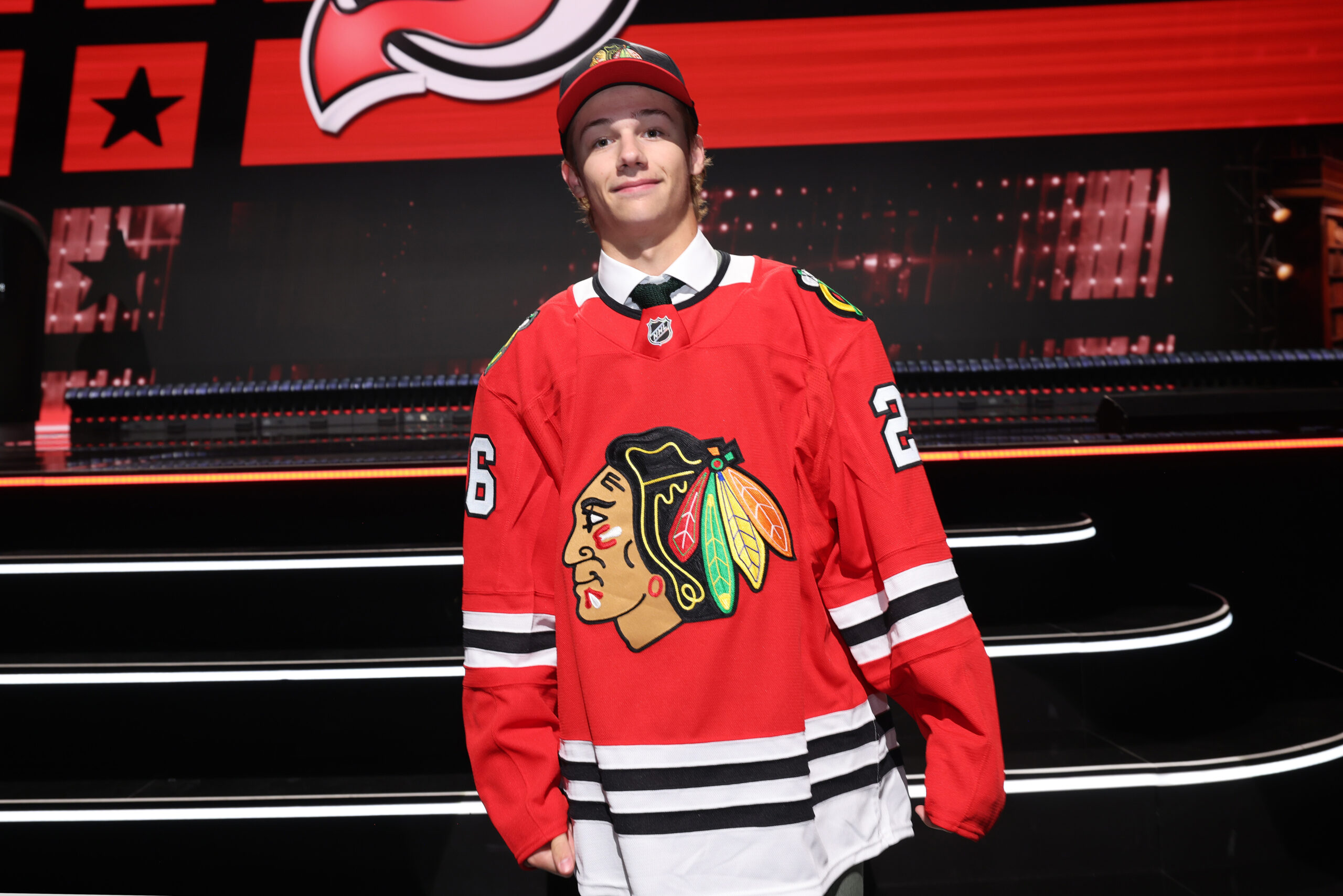
Xavier Villeneuve wants to make a difference every time he steps onto the ice. Boston University is teaching him how much more dangerous he can become when he waits a little longer to do it.
For a defenseman whose game runs on movement, deception and an appetite for creating offense, slowing things down can feel like a concession. Villeneuve arrived in the NCAA this season eager to get involved, sometimes moving ahead of the puck before the play was ready for him.
In trying to give his teammates an option, he could end up taking one away.
A few games in, a steady diet of video helped him recognize the difference.
“For me, it was about being patient. Sometimes, I’m an impatient guy on the ice,” Villeneuve said to Ratings. “I got blamed for jumping into the game too quickly. Every time I wait a second or so, when I get to a guy, it’s very rare that I get stopped.”
Through nine games with the Terriers, the Chicago Blackhawks prospect has one goal and eight assists. That is an encouraging opening to his NCAA career after he was selected 34th overall in the 2026 NHL draft. Yet the most revealing part of his start might be how readily he can explain what still needs to improve.
Finding Time Against Stronger Competition
Villeneuve arrived at BU about a month before the season began. He joined a team that had time to get acquainted before the demands of classes and road trips took over.
“We didn’t have school yet, so we were just together every day. We were practicing,” Villeneuve said. “It was fun, but everyone was looking forward to playing.”
There was time to build familiarity, but the anticipation grew as the season approached. When the schedule finally began, the Terriers headed to Alaska, an introduction to college hockey that also came with a lengthy trip across the continent.
The more consequential adjustment happened once the puck dropped.
“The guys are all stronger. At the beginning, there was a little less time and space,” Villeneuve said. “I’m also a guy who usually starts pretty slow. I remember my first year of junior, it was the same. I got there at 140 pounds and the guys were all huge compared to me.”
That earlier experience gave him a reference point, although recognizing the challenge did not eliminate the need to work through it.
“The first games, it took me time. I had to observe. The guys were coming fast,” Villeneuve said. “But from game to game, it’s getting better and better.”
The demands also extend beyond the physical matchup. With fewer games on the schedule, Villeneuve sees opponents who have the energy to sustain their defensive effort.
“We play fewer games. There’s no one who can say, ‘I’m tired, I’m not going to defend.’ It’s the same thing on our side,” Villeneuve said.
The puck still needs to move, and he still wants to draw defenders toward him before finding the space they leave behind. Executing those plays requires a better understanding of when that space will become available.
The skill around him helps offset that pressure. His teammates can recognize when he is drawing coverage and anticipate where the next opening will appear.
“In the NCAA, you have four lines of incredible players capable of reading and feeding off your plays,” Villeneuve said. “I think it’s similar in both cases. Yes, the opposition is stronger, but your team is strong too.”
That has allowed him to preserve the creativity in his game while adjusting its timing. The early points suggest his offense is translating, even as he continues to get comfortable with the speed and strength around him.
Malhotra Creates Space And Lawrence Sets The Pace
The Boston University Terriers have quite a few drafted prospects. Two stand out above the rest: Vancouver Canucks third overall pick Caleb Malhotra and St. Louis Blues 11th overall pick Tynan Lawrence.
Villeneuve’s appreciation for Malhotra begins with a friendship that has followed them into their first college season. The two are roommates at BU, which has given Villeneuve a chance to know the personality behind the player.
“We’re both a little similar, but I would say he’s calmer,” Villeneuve said. “As soon as you dig a little under that shell, he’s a really funny guy. We get along pretty well. There hasn’t been a day here where I haven’t had a laugh with this guy, so it’s going well so far.”
On the ice, Malhotra gives him a different reason to smile.
“He produces chances out of nothing. Sometimes he’s going to have three guys on him, but he’s going to see a guy in the corner of his eye and send him a tape-to-tape, behind-the-back pass,” Villeneuve said. “Not many people are able to do that. He’s a complete player with a really big brain.”
The early scoresheet did not always reflect what Villeneuve saw. Even before Malhotra’s production began to pick up, Villeneuve believed the quality of the opportunities was there.
“He generated tons of Grade A chances,” Villeneuve said. “And he does it sometimes with double or triple coverage. It may look like he’s about to lose the puck battle, and then, all of a sudden, he’s going to send a teammate on a breakaway and catch everyone off guard.”
Their work together on the power play offers a closer look at how Malhotra makes the players around him more effective.
“I play on the power play with him and it’s easy,” Villeneuve said. “Everyone can play on a power play and say, ‘I did my job,’ but he won’t just do his job. He’s going to buy you a little more time so that your job is easier.”
Those details matter to a defenseman trying to manipulate coverage at the top of the zone. The extra time Malhotra creates can allow Villeneuve to move into a better position before the puck reaches him.
Tynan Lawrence challenges opponents in a different way.
Lawrence arrived with the benefit of having already spent part of the previous season at BU. Villeneuve believes his current play answers the questions that may have followed that earlier introduction.
“I think last year, there were people who doubted a little bit because of his production or whatever. But this year, he’s been incredible,” Villeneuve said. “Tynan has a relentless engine that makes him so difficult to contain.”
That motor comes with enough skill to make Lawrence a handful, something Villeneuve experiences in practice.
“It looks like he’s never tired. He doesn’t stop. He’s got skills and a great shot, but his effort is always there,” Villeneuve said. “All of that together makes him a monster to deal with in practice and in games. You don’t want to go into the corner against him, trust me.”
For Villeneuve, practicing alongside both provides a daily test of how quickly he reads and responds to different kinds of threats.
Chicago Offers Motivation While BU Holds His Attention
Early-season success brings excitement from a franchise eager to reach the next phase of its rebuild, and Villeneuve hears the enthusiasm from Blackhawks fans. He understands how quickly the reaction can shift, which makes keeping his own perspective essential.
“I hear them, even when I try to block out a lot of the noise to stay as concentrated as possible. They’re super passionate and I love it, but I need to maintain this level of play and build on it if I’m going to be worth the praise when it’s time,” Villeneuve said. “But, yes, I see the comments from Chicago fans and it’s been really great.”
The prospect of eventually contributing in Chicago, alongside the likes of Connor Bedard, Anton Frondell and Roman Kantserov, gives purpose to the work he is doing now.
“It’s an extra motivation where I remind myself that, for me to get there, I need to be the best version every single day. Every shift matters and every day is an opportunity to improve,” Villeneuve said.
Before he was drafted, Villeneuve never missed a Montreal Canadiens game. Now he follows both Chicago and Montreal every week, watching some of the best young players in the NHL.
The dream is very real, but his immediate goals are more grounded.
“My goal is to be there one day, but, right now, BU is my priority. I want to win a national championship. That’s why I came here,” Villeneuve said. “But yes, sometimes I’ll watch the Blackhawks play on the power play and wonder, ‘What would I look like there?’”
His perspective also shapes how he handles comparisons with Lane and Cole Hutson, whose success at BU makes them familiar reference points for a creative young defenseman.
Villeneuve appreciates the example they provided, but he sees distinctions between their games and wants his own development judged on its merits.
“I’m Xavier. I want to be myself,” Villeneuve said. “I’m convinced that when Cole Hutson came here, he didn’t just want to say, ‘I’m Lane’s brother.’ The way they play, even if they’re dynamic, they’re totally different. It’s the same for me.”
There is ambition behind that answer as well as independence.
“I want to be my own person. One day, I’m going to play against those guys, I’m going to want to be even better than those guys and I’m going to want to beat those guys,” Villeneuve said.
For now, the opportunity is to build toward that standard through his work at BU, where the attention surrounding his future comes with a clear responsibility in the present.
Using Video And Analytics To Understand The Details
The adjustments in Villeneuve’s game are being reinforced through frequent work with Jay Pandolfo’s coaching staff. One of the earliest lessons involved recognizing when his eagerness to participate was making a possession more difficult.
“It was more about how I positioned myself. I’m a guy who wants to make a difference,” Villeneuve said. “Sometimes it happened that I was above the puck and it took away options and time. After three or four games and daily video sessions, I really understood that part.”
The review gave him a clearer picture of when to enter the play. Instead of arriving before a passing option had developed, he could let the sequence unfold and attack with better timing.
“There are defensive aspects, like how I can place my stick to cut plays or how to use my body,” Villeneuve said. “The coaching staff has been exceptional at teaching some of these details to help tweak how we can impact the play without the puck.”
Against older, stronger opponents, positioning can determine whether he gets a chance to disrupt a possession or spends the shift trying to recover.
“It’s about how I position myself in my zone. I’ll see plays coming and it’ll look easy,” Villeneuve said. “When I’m in the right position, Jay [Pandolfo] will often say: ‘The puck will find you if you stop in the right spot.’ And he’s absolutely right.”
Positioning still has to be supported by technique and effort when a larger opponent gets the puck into a protected area.
“Sometimes you’re one-on-one, straight in the corner. Your opponent is a 6-foot-6, 235-pound guy. I have to find a way to have my stick under him, otherwise he’ll just wait and make a play,” Villeneuve said. “There’s that part, but there’s also a big part that comes from me. How I compete and the will to win that puck.”
Analytics provide another way to assess that work.
Villeneuve said the team’s reviews are driven primarily by sequences and details. In his individual work with the defensive coach, numbers add another perspective.
“My defensive coach and I will check some advanced stats, like expected goals, to add another layer of context to our video sessions,” Villeneuve said. “Sometimes you’re like, ‘I don’t have a point in that game,’ but you generated chances. You see the numbers, you’re like, ‘I should have had one or two in that game.’”
The same principle applies defensively. He wants to understand the plays behind a result, including the contributions that can disappear from view when a shift ends with a goal against.
“Sometimes defensively, let’s say I’m minus-two in that game, but I blocked off a lot of passes or I blocked six shots in that game. Looking at your overall impact through analytics will help confirm the eye test,” Villeneuve said. “You can then say, ‘I just wasn’t lucky in that game.’ Sometimes it’s the opposite, you got more than you thought. It’s fun to watch. It’s an excellent tool.”
That perspective matters for a player who finds it difficult to leave a defeat at the rink. Villeneuve’s competitive streak extends to offseason games with his older brother and the small-area battles that fill a practice week.
“For me, it’s winning. I’m a very good winner when I win, but I hate losing,” Villeneuve said. “In a game, I’m not able to sit there and do nothing. I want to make the difference and I cannot stand to lose.”
BU is helping him give that urgency more direction, turning his desire to affect every game into specific decisions he can study and improve. He still wants to be the player who changes a result, but he is learning that doing so can require holding his position or allowing a play to develop before joining it.
Chicago remains the ambition, and a national championship is the goal in front of him. Through his opening weeks with the Terriers, Villeneuve is learning how to pursue both with the patience his game increasingly demands.